
Dr Neda Naghshbandi
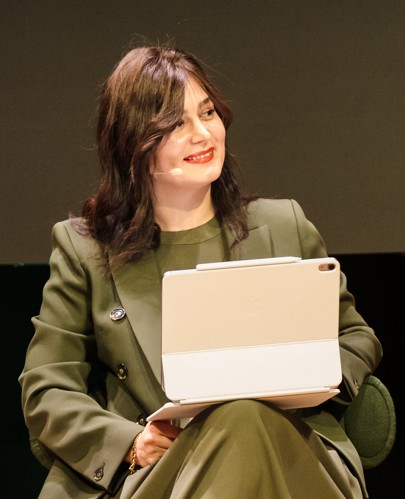
1. Tell us about your role and what you find most exciting about it.
I’m a Technical Director at AtkinsRéalis, a global engineering and consultancy firm, where I work at the intersection of infrastructure systems, AI, governance, and operation. My focus is on how we apply technology to improve complex infrastructure systems such as transport, not just at an asset level, but across entire ecosystems. At the moment, my focus is on shaping AI adoption at scale.
In fact, my work has evolved from traditional engineering into something more systemic, understanding how infrastructure, organisations, data, and people interact, and how we can better integrate them to enable smarter, more resilient systems.
What excites me most now is shaping thinking at a sector level. Rather than solving isolated problems, I’m increasingly focused on bringing together stakeholders, technologies, and disciplines to support strategic, transformative initiatives, particularly where AI and digital capabilities can unlock new ways of operating.
It’s that shift, from designing individual components to influencing how whole systems and ecosystems evolve, that I find most rewarding. It’s complex, but that’s exactly where the real impact is.
2. What inspired you to become an engineer?
My interest in engineering started quite early, through a strong curiosity for maths and physics. I was always drawn to problem-solving, understanding patterns, breaking down complex ideas, and figuring out how things work. At school, those subjects felt natural to me, and I found myself enjoying them far more than others.
When it came to choosing my path at university, I faced a decision: stay within pure maths and physics, or apply that knowledge in a more practical way. Engineering stood out because it bridges theory and real-world impact it gives you the ability to turn abstract thinking into something tangible.
I chose civil engineering not only because I was interested in the infrastructure that shapes our daily lives, but also because I wanted to challenge the norm. It was, and still is, a male-dominated field, and I felt strongly about proving that it shouldn’t be. That decision became part of my identity, not just pursuing engineering, but redefining what it can look like.
Since then, my journey has evolved significantly, from engineering into construction management, and later into complex adaptive systems and emerging technologies like AI. But the underlying motivation has remained consistent: applying analytical thinking to solve meaningful, real-world problems, and constantly pushing beyond traditional boundaries of engineering.
Over time, my focus shifted from building individual assets to understanding how entire systems behave. I went on to complete a PhD in complex adaptive systems, with a focus on multi-agent system design and simulation, exploring how infrastructure systems evolve, interact, and respond to change.
That naturally led me into AI and system-level thinking. Today, what drives me is the same core idea I started with, applying analytical thinking to complex, real-world challenges, but at a different scale: not just engineering components, but shaping intelligent, adaptive systems that can operate and improve over time.
3. How do you balance your professional and personal lives?
I’ll be honest, this hasn’t always been easy, especially when you’re ambitious and want to keep moving forward in your career. There are periods where work naturally takes priority. I also recognise that balance looks different for everyone, there isn’t a single formula. What has worked for me is being quite deliberate about how I structure that balance over time.
I tend to work intensely for periods and then take proper time off to reset. When I switch off, I really switch off, often through travelling, especially around Europe, experiencing different cultures, food, people, and nature. That helps me reconnect, recharge, and come back with a fresh perspective.
And when it comes to the people in my life, it’s not always about frequency, but quality. I make sure I carve out meaningful time for friends and family, those moments, even if they’re not constant, are what keep me grounded. Over time, I’ve come to see balance less as something you achieve every day, and more as something you shape intentionally over the long term.
4. In your opinion is there more that can be done to encourage a greater diversity of people into engineering careers?
Yes, definitely, we’ve made progress, but I don’t think we’ve fully addressed the root of the issue yet. We need to shift how engineering is positioned. It’s often framed as purely technical, but in reality, it’s creative, collaborative, and increasingly interdisciplinary. The challenges we’re solving today, from infrastructure to sustainability to digital transformation, need diverse perspectives.
For me, more specifically, it starts with earlier and more honest visibility. Not just showcasing diverse role models, but showing the full spectrum of what engineering really looks like today. My own path hasn’t been linear, from civil engineering into systems thinking and AI, and more recently ecosystem integrator to shape strategic transformation, and I think making these non-traditional journeys more visible can really open doors for people who might not initially see themselves as engineers.
I’ve also seen firsthand how powerful representation can be. I attended the Women in Rail Awards ceremony, and it was genuinely inspiring to see the depth and impact of women’s contributions across the sector. It makes you realise not only how much progress has been made, but also how powerful you can be when you step into these spaces.
And beyond attracting people, we need to focus on retaining them. Creating environments where people feel they can grow in different directions, bring their full perspective, and shape the future of the field is key. Diversity isn’t just about who enters engineering, it’s about who stays, thrives, and leads.
5. What advice would you give for anyone interested in pursuing an engineering career?
Stay curious and don’t feel like you have to follow a single, predefined path. Engineering is evolving so quickly, and some of the most exciting opportunities now sit at the intersection of disciplines, that’s where real innovation happens.
Build strong fundamentals, but don’t stop there. Explore how your skills can be applied in different contexts and allow your interests to evolve. My own journey has moved across engineering, management, and systems thinking, and finally sector leadership and that’s exactly where I’ve found the most value.
Also, don’t let stereotypes or expectations limit you. Engineering needs different perspectives now more than ever. There isn’t one way to be an engineer.
And most importantly, all the doors are open to you. Knock on them, step in, and don’t wait for permission to belong.
Don’t underestimate the superpower you bring when you’re starting out. Coming fresh out of university, you’re often closer to the state of the art than you realise, and you bring a level of creativity and fresh thinking that can be incredibly valuable.
Sometimes, more experienced professionals can be deep in established ways of working, and that’s where your perspective matters. You see things differently, you question assumptions, and that’s exactly what drives progress.
So trust that. Speak up, stay curious, and don’t hold back, your voice and your ideas are needed more than you think.